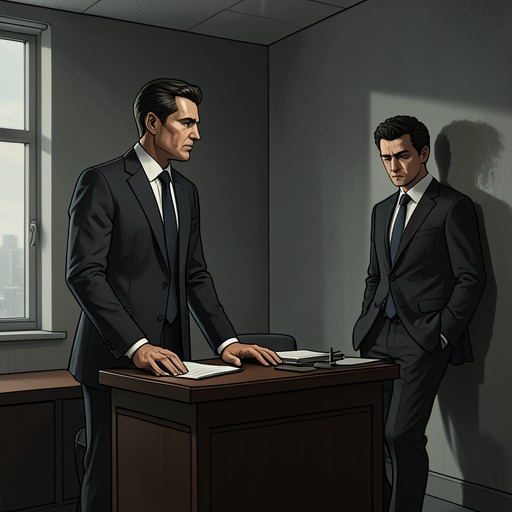
Police Appeal for Information on Frank
The Hanging GirlCarl Mørck’s public appeal for information about Frank turns an old, officially dismissed road death into a case that can no longer be kept out of public view. At a press briefing called to discuss another investigation, Carl displays a photograph of a man beside a Volkswagen Kombi and asks viewers to help identify him. The appeal is an act of investigative defiance as much as a request for tips: Lars Bjørn tries to stop it, but Carl puts the photograph and Department Q’s contact number before the cameras anyway. Within about an hour, a viewer’s call gives the team a concrete lead on the vehicle.
A Case Reopened Against Resistance
The appeal grows out of Department Q’s review of Alberte Goldschmid’s death on Bornholm in 1997. The papers Superintendent John Birkedal had given the investigators had not been updated since 2002, and the original inquiry had never considered the possibility that the collision was deliberate. Carl recognizes several possible reasons for that failure, including institutional reluctance to keep an unsolved murder open and an inadequate examination of the impact site. He also considers a more personal explanation: Christian Habersaat’s forceful insistence on his theories may have made colleagues stop listening rather than investigate further.
The case had already met resistance inside police headquarters. When Carl brought a photograph of the man with the VW to Lars Bjørn’s office, he asked permission to put out a missing-person report on TV2’s Station 2. Bjørn rejected the request, treating the matter as the 1997 case that Bornholm Police had dismissed and insisting that there was no murder case or special suspicion to discuss. Carl’s later decision to use a press briefing for the appeal bypasses that refusal in public, where the chief cannot quietly keep the photograph out of circulation.
The investigation was not based on the photograph alone. Carl had tasked Assad with sending Christian Habersaat’s drawings to technicians and asking them to revisit the wooden-board evidence. The questions included whether a board thick enough to carry a shovel blade could have survived the collision, whether such an assembly could have been attached to a VW Kombi without leaving marks, and whether Alberte’s body might have been thrown against the windshield and broken it. The team also wanted a sharper version of the image of the man beside the vehicle. These were investigative possibilities to test, not established facts; the public appeal made the search for the man one strand of a broader effort to reconstruct the collision.
The Appeal at the Briefing
At the televised briefing, Carl describes the wanted man as about six feet one, with a chin dimple, blue eyes, strong features, dark eyebrows, wide front teeth marked by a small light spot, and a husky voice. He says the man speaks fluent Danish and is known as Frank, though he has since changed his name to something more exotic. Carl holds up a photocopy of the man beside the VW Kombi so viewers can compare the description with the face.
He also supplies details about the vehicle: a light-blue VW Kombi with a wide fender and a large peace sign painted on the roof. The man had been staying on Bornholm in 1997 and had taken part in excavations of timber circles, platforms resting on thick posts that were used for sun worship and offerings of stone and animal bone. Carl says the team knows Frank is a sun worshipper and believes he may still practice. That description connects a distinctive vehicle and face to a place, period, and religious activity, giving the public several ways to recognize a possible lead.
Lars Bjørn attempts to pull the briefing back to its announced subject, the nail-gun case, and tells Carl to stop. Carl instead directs viewers to contact Department Q, points to the phone number beneath the photograph, and says the team is waiting for their information. The collision between the official agenda and Carl’s appeal is plain: he uses the audience assembled for one case to seek help with another, even as he risks his position. He leaves the photocopy on the briefing-room table for journalists to see, but Bjørn removes it before they can reach it. The attempt to suppress the image does not undo the televised appeal.
The First Response and Its Limits
The response arrives with striking speed. A surgical nurse, Kitte Poulsen, watches TV2 News over the internet during her lunch break in Kuala Lumpur and recognizes the Kombi. She tells the investigators that it probably belonged to her father, Egil Poulsen, a peace activist until the mid-1980s. Egil has died, but his wife still lives in the family’s old house in Brønshøj. Kitte last saw the vehicle when she came home for Christmas; it had been put up on blocks in the garden.
The report gives Department Q a specific route to pursue: a named former owner, a surviving family member, and a vehicle associated with a home in Brønshøj. It does not, by itself, establish who was driving the Kombi in 1997 or prove that its owner was responsible for Alberte’s death. Its value is that it converts Carl’s public description into a traceable lead. He is astonished that Department Q has received a response less than an hour after the briefing, after years in which the island’s population and police had not produced the same result.
Investigative Significance
The appeal changes the scale of the inquiry. Earlier investigators had treated Alberte’s death as a closed accident; Carl’s questions about the board, the shovel blade, the vehicle’s bodywork, and the windshield reopen the physical reconstruction, while the broadcast takes the search beyond the original local investigation. The photograph becomes both evidence and a public instrument: potentially useful because it is recognizable, but not sufficient on its own to identify a driver or establish guilt.
The later evidence also makes the distinction between finding Frank and solving the killing essential. June Habersaat eventually tells the investigators that she, not Bjarke, killed Alberte, while Christian Habersaat’s written account interprets Bjarke’s jealousy and the poem about Frank as the explanation for his son’s actions. Those revelations place Frank within the family history surrounding the case, but they do not turn the press appeal into proof against him. Its decisive result is narrower and more practical: it breaks the search’s dependence on an old file and prompts a viewer to connect the photographed Kombi with a real family and location.